
La leche materna es el mejor alimento para su bebé durante el primer año. La leche materna no solo contiene un equilibrio ideal de nutrientes para su bebé, sino que también contiene anticuerpos que pueden ayudar a proteger a su bebé de ciertas enfermedades. Cuando una madre no puede o elige no amamantar, los bebés deben recibir fórmula infantil. La leche materna o la fórmula es el único alimento que necesitarán hasta que tengan entre 4 y 6 meses de edad.
The journey of introducing solid foods to your infant is an exciting milestone filled with new flavors, textures, and a fair share of messy faces. However, it can also bring up a lot of questions for parents. To help families navigate this stage, we have compiled the latest guidance on introducing solids, managing food allergies, and transitioning to finger foods.
Signs your baby is ready for solid foods
When your baby is developmentally ready for solid foods, it is important to offer a variety of foods, flavors, and textures. Current dietary guidelines emphasize limiting added sugar and salt in your baby’s diet. Instead, parents should focus on foods with the nutrients that babies need to grow and develop, such as iron, zinc, and vitamin D.
Organizations like the American Academy of Pediatrics (AAP) and the World Health Organization recommend starting solids around six months of age, but every baby develops at their own pace. Before giving your baby solid foods, look for these 3 signs that they’re ready:
- Head control: your baby can hold their head steady and upright throughout a meal.
- Sitting upright: your baby can sit with little to no support.
- Loss of the “tongue-thrust” reflex: your baby won’t push their tongue out when they get food. This reflex is nature’s way of preventing choking; it needs to fade so they can actually swallow.
Once the physical skills are there, look for these “I’m interested” cues:
- Watch and reach: your baby leans forward when you eat; they track your fork with their eyes, or try to grab food off your plate.
- Munching motions: you might see your baby move their jaw up and down or make chewing motions with their mouth while they watch others eat.
- Improved coordination: your baby can bring objects (like toys) to their mouth.
Food allergies
One of the most common concerns for new parents is the risk of food allergies. An allergic reaction occurs when the body’s immune system negatively reacts to a protein in a specific food, which is different and usually more serious than a simple food intolerance. Almost any food can cause an allergic reaction, but there are nine common allergens known as the “Big 9”: cow’s milk, eggs, fish, shellfish, tree nuts, peanuts, wheat, soybeans, and sesame.
While it is impossible to completely prevent food allergies, introducing these common allergens early and often, starting when your baby is around 6 months old, can help reduce the risk. For most children, it is not necessary to consult a doctor before introducing peanuts. If your infant has severe eczema, an egg allergy, or both, they are at an increased risk. You should discuss introducing peanut foods with your healthcare provider, ideally before your baby turns 4 months old. Watch for allergic symptoms such as hives, red and itchy eyes, diarrhea, or sneezing. If your baby has difficulty breathing, facial swelling, vomiting, or diarrhea after eating, call 911 immediately.
Feeding styles
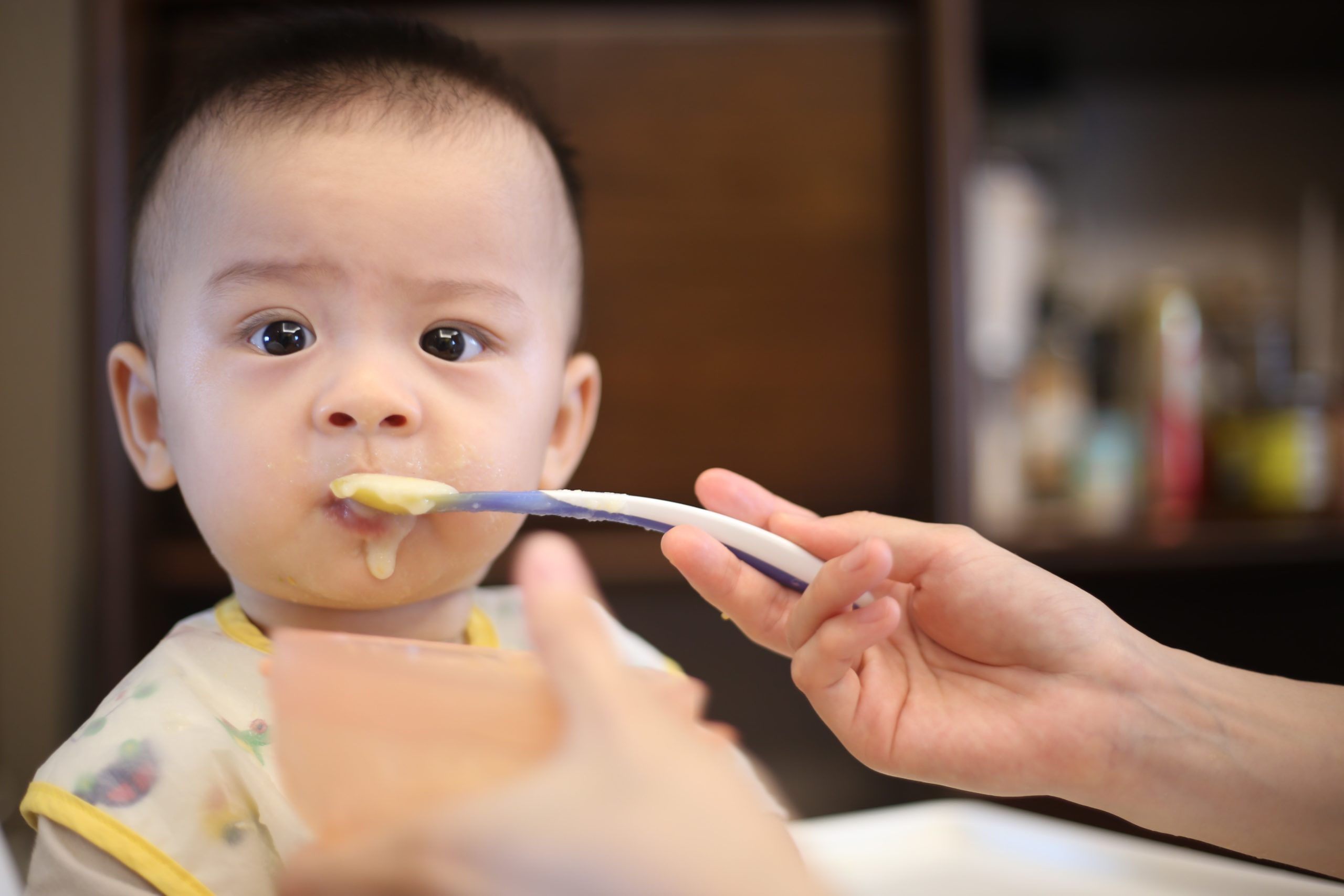
Parents can choose different feeding styles. Some parents opt for more traditional spoon feeding, other parents opt for a style called baby-led weaning, and some parents do a mix of both.
Traditional feeding typically involves a caregiver feeding the baby smooth textures like infant cereals or pureed fruits and vegetables from a spoon. A self-feeding approach, like baby-led weaning, focuses on offering finger foods so the baby can practice feeding themselves. This method encourages infants to touch, play with, and visually explore their food. While it can be messy, it is an important step in learning how to eat independently. The most important part is to always stay with your baby while eating. If your baby chokes, they will not be able to cry to let you know.
Prevent choking
Gagging is a noisy, normal reflex that helps prevent choking. Gagging or coughing will bring food up and away from the airway. Your baby does not usually need your help with gagging.
Choking is not normal. When the airway is blocked, a baby will make little to no sound and may turn blue. A choking baby is in distress and needs help right away. To help prevent choking, wait to offer solid foods until your baby is developmentally ready, and never put pieces of food into your baby’s mouth.
It’s important to be prepared in case of a choking emergency. Learn infant CPR through classes from the American Red Cross (redcross.org) or American Heart Association (americanheart.org).
How to introduce solid foods
Use these tips to offer solid foods to your baby:
- Put your baby upright in a high chair with their feet flat against a board.
- Start by offering a tablespoon or two of small pieces of soft foods to your baby. Don’t force feed your baby extra food, instead let them show you if they’re still hungry and want more. Babies are great at knowing when they are hungry and full, so let them decide how much they want to eat.
- Don’t worry if they reject a food the first time—this is normal as they’re getting used to new flavors and texture. Try offering the food again in a few days
- Around the age of 6 months, your baby may grasp strips or sticks of soft foods using their whole hand. Cut soft foods into long strips, sticks, or spears that are about 3 inches long and easy for your baby to pick up with their whole hand.
- Next your baby may start to use a thumb and pointer finger. They will start to pick up smaller objects, like toys or small pieces of food. Cut soft foods into small finger food pieces – about the size of a chickpea.
- If your baby was born early, has difficulty swallowing, or is not interested in picking up food, talk to your healthcare provider before starting finger foods.
Finger foods
Babies normally start eating finger foods around 9 to 10 months. This is when they begin learning to use their thumb and fingers to pick up small objects. Finger foods are an important step in helping them learn how to self-feed.
Excellent finger food options include:
- Sliced avocado
- Cooked and mashed beans
- Chopped hard-boiled eggs
- Small pieces of soft quesadilla or grilled cheese
- Cooked, diced sweet potato or zucchini
- Chopped fruits like peaches, papaya, kiwi, or banana
Foods to avoid
Don’t give your baby these foods until they’re 12 months of age to help them stay safe and healthy:
- Honey: Avoid honey on its own or in baked goods. Babies can get sick from eating honey before they’re 1 year old.
- Cow’s milk: Do not replace breast milk or formula with cow’s milk. However, it is safe to offer small amounts of dairy products like cheese or yogurt starting at 8 months old.
- Choking hazards: Avoid hot dogs, nuts, seeds, popcorn, chips, whole grapes, raisins, raw vegetables, chunks of meat, and candy.
As your baby grows, have your family sit together at the table during meals. Let your baby touch, play with, and explore their food. By the time they are 1-year old, they will likely be eating most of the same foods as the rest of the family.